
The Master of Business Administration (MBA) remains one of the most sought-after credentials in the professional world. It’s often the key to unlocking C-suite roles, significant salary bumps, and successful career pivots.
But then there is the sticker shock.
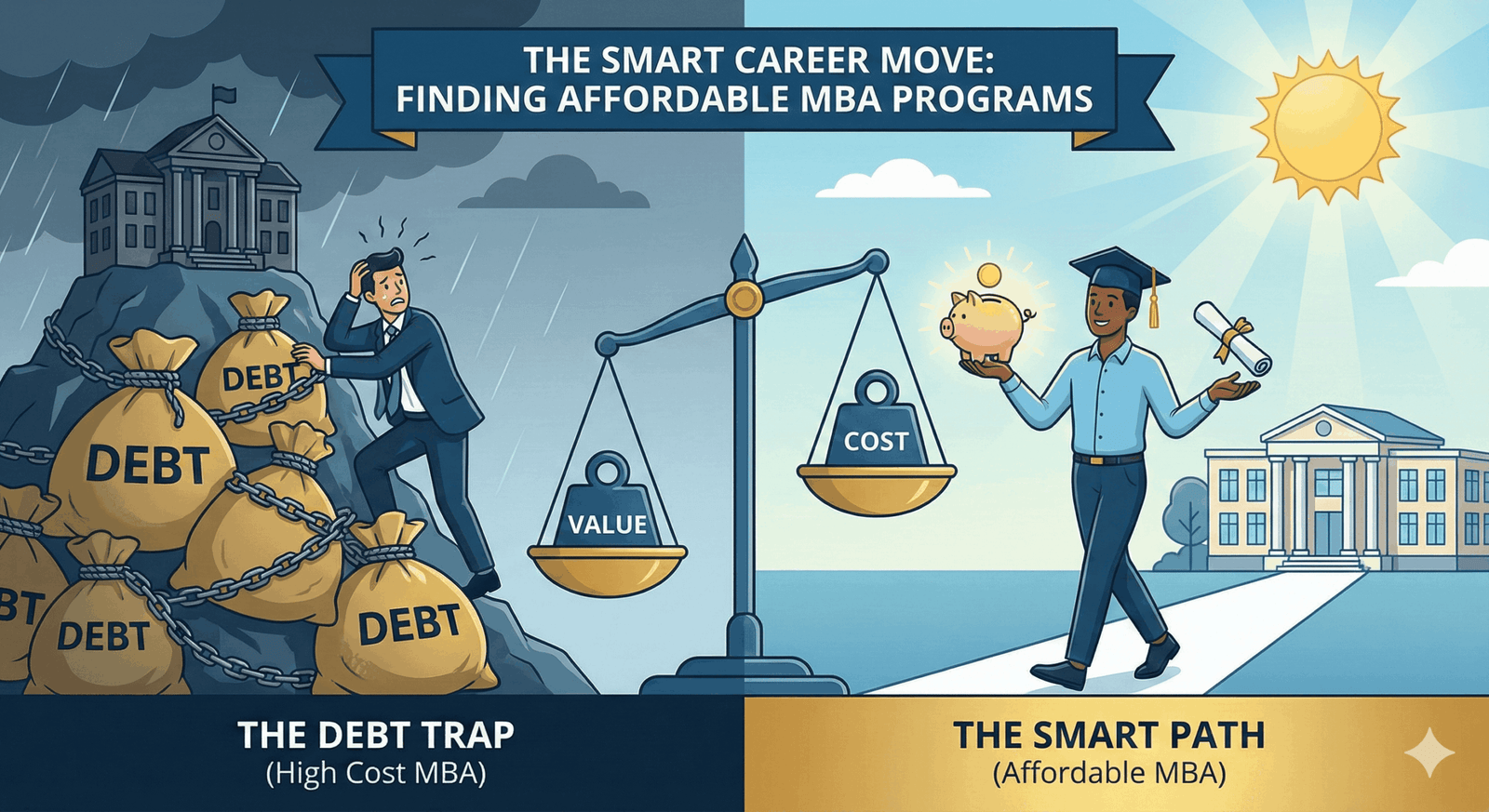
Top-tier, “brand name” MBA programs frequently come with eye-watering tuition tags exceeding $150,000—and that doesn’t include the “opportunity cost” of lost wages if you quit your job to attend full-time. For many professionals, this creates a paralyzing dilemma: Is the potential career boost worth crippling debt?
Fortunately, the landscape of business education has shifted dramatically. The binary choice between “elite and expensive” or “cheap and questionable” is gone. Today, high-quality, accredited, and respected MBA programs exist at price points that make financial sense.
Finding an affordable MBA isn’t just about finding the lowest number; it’s about maximizing your Return on Investment (ROI). Here is a strategic guide to navigating the search for a budget-friendly business degree.
1. Redefining “Affordable” and Focusing on ROI
Before you start Googling schools, you need to define what affordable means to you.
An MBA is an investment product. The goal isn’t just to spend less; it’s to ensure the cost of the degree is quickly eclipsed by your increased earning potential.
- The $150k Mistake: If you spend $150,000 on tuition to get a $20,000 raise, your payback period is enormous.
- The Smart Play: If you spend $30,000 on tuition to get the same $20,000 raise, your ROI is exceptional.
Action Step: Determine your budget ceiling. Are you looking for a program under $25,000 total? Under $50,000? Knowing your hard limit will immediately narrow your search and keep you focused.
2. The Three Pillars of Affordable MBAs
Where do these mythical “affordable but good” programs hide? They generally fall into three categories.
A. Public Universities (The In-State Advantage)
State university systems often offer incredible value, particularly for residents. Many state flagship universities have business schools that rival expensive private institutions in curriculum quality and faculty, subsidized by state funds.
- The Strategy: Look first at public universities in the state where you currently reside. The in-state tuition rate is usually the lowest possible price point for a brick-and-mortar experience. Even out-of-state tuition at many public universities is often significantly cheaper than private competitors.
B. The Online MBA Revolution
This is the biggest game-changer in MBA affordability. In the last decade, prestigious universities have launched 100% online MBA programs.
Because universities don’t need to pay for physical classrooms, campus overhead, or student centers for remote learners, they can pass those savings to you.
- The Strategy: Look for established brick-and-mortar universities that offer an online version of their degree. These often use the same faculty as their on-campus programs. The degree you receive usually doesn’t even specify “online”—it just says “MBA.”
C. Regional Universities with Strong Local Ties
Don’t get blinded by national rankings. There are hundreds of excellent regional universities whose business schools are highly respected within their specific geographic area or industry niche.
- The Strategy: If you know you want to work in a specific city or region long-term, look at the local universities there. They often have lower tuition and stronger recruiting ties to local employers than a pricey out-of-state school.
3. Hacking the Cost: Funding Your Degree
Finding a program with low tuition is step one. Step two is paying even less than the sticker price.
The “Employer Sponsorship” Holy Grail
The most affordable MBA is the one someone else pays for. Many mid-to-large-sized companies have tuition reimbursement programs as part of their benefits package.
- Check HR: Do not assume your company doesn’t offer this just because they don’t advertise it. dig through your benefits handbook.
- The Pitch: If a formal program doesn’t exist, write a proposal to your manager. Explain how specific courses in the MBA will directly benefit your current role and the company’s bottom line.
Graduate Assistantships (GAs)
If you are looking at on-campus programs, investigate Graduate Assistantships. In exchange for working part-time for the university (researching, grading papers, or administrative work), many schools offer significant tuition remission and sometimes a small stipend.
4. Vetting Quality: Avoiding “Diploma Mills”
When chasing affordability, you must be wary of “degree mills” that offer cheap, fast degrees with zero actual value.
The essential litmus test is accreditation.
In the United States and much of the world, the gold standard for business school accreditation is the AACSB (Association to Advance Collegiate Schools of Business). Less than 6% of the world’s business schools hold this accreditation.
Other respected accreditations include AMBA and EQUIS (more common internationally) and ACBSP (often found in smaller U.S. colleges and highly focused on teaching quality).
The Rule: If a program is suspiciously cheap and lists no recognized programmatic accreditation, walk away. Employers will not respect the degree.
Conclusion: The “Perfect” MBA is the One That Fits You
If your goal is to work in private equity on Wall Street, you might need the network that only a top-20, expensive school can provide.
But for the vast majority of professionals—those looking to move into management, switch industries, or sharpen their strategic thinking—an affordable, accredited MBA from a respected public or online university will open the exact same doors, without the decades of debt.
Start your search by defining your budget, prioritize AACSB accreditation, and explore the growing world of high-quality online education.