
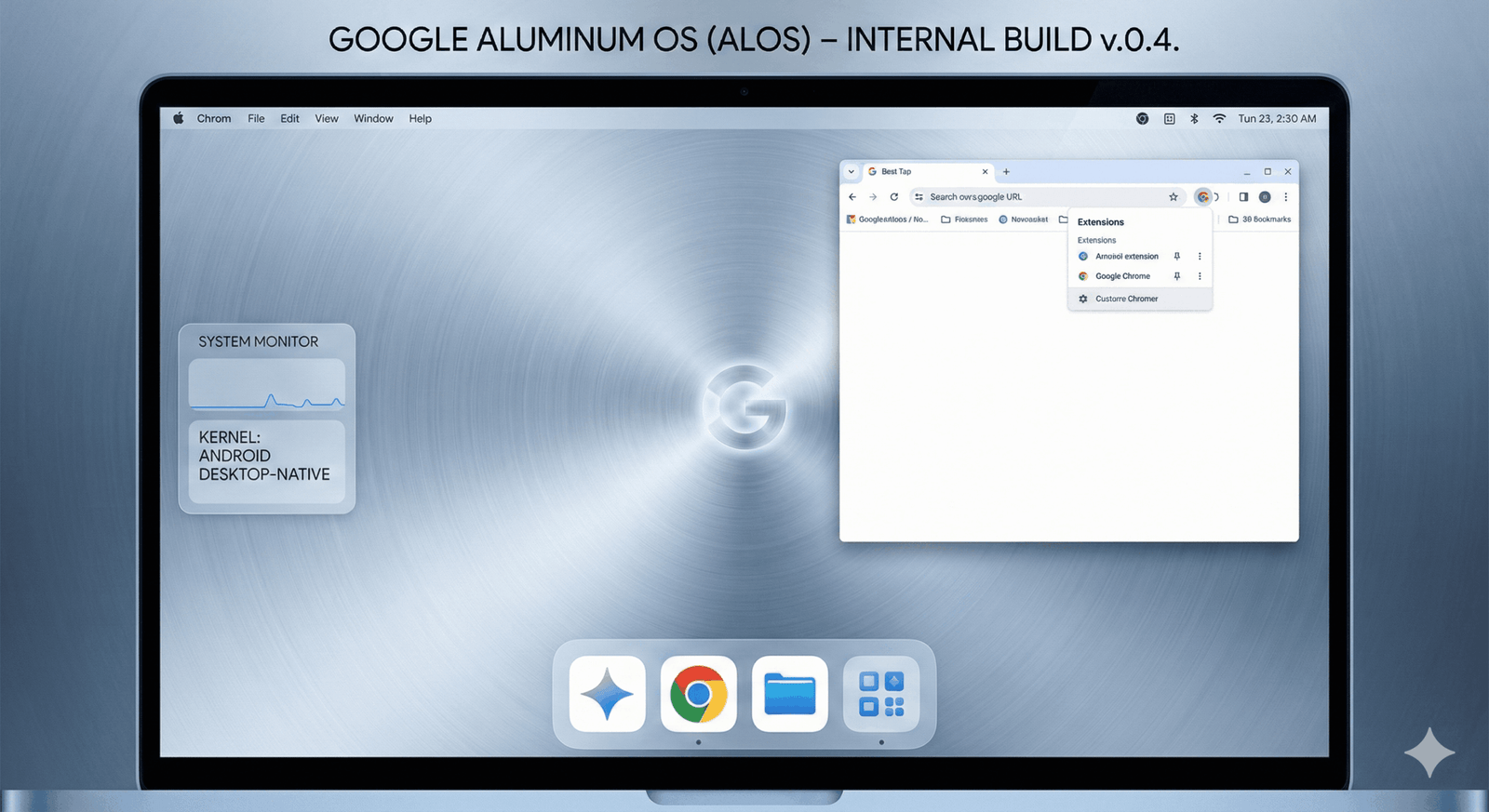
The rumors were true. After years of speculation about Google merging Android and ChromeOS, we finally have concrete proof.
In a massive slip-up this week, a Google engineer accidentally uploaded a screen recording to the public Chromium Issue Tracker, revealing a fully functional build of “Aluminum OS” (internally codenamed Aluminium). The bug report was quickly restricted, but not before screenshots spread across X (formerly Twitter) and Reddit.
This isn’t just “desktop mode” for your phone. This is Google’s dedicated Windows killer.
The Leak: What Did We See?
The leaked video showed an HP Elite Dragonfly Chromebook running a software build labeled “ALOS” (Aluminum OS). Unlike the current ChromeOS, which runs Android apps in a container, this OS is Android—but heavily modified for mouse and keyboard.
Here are the key features revealed in the leak:
1. The “Tall” Status Bar Gone is the tiny mobile status bar. Aluminum OS features a taller, translucent top bar similar to macOS, housing a dedicated “Gemini” AI button, Wi-Fi controls, and a new “Focus Mode” toggle.
2. The Centered “Start” Dock Borrowing from Windows 11 and macOS, the app dock floats at the bottom center of the screen. It features a new “App Library” button that opens a desktop-optimized app drawer, rather than the full-screen mobile view we are used to.
3. Chrome Extensions on Android This is the holy grail. The video showed a Google Chrome window open with active extensions visible in the toolbar. For years, the biggest weakness of Android tablets was the “mobile” version of Chrome. Aluminum OS appears to run the full desktop browser natively.
4. Free-Form Windowing The leak demonstrated “snap layouts” identical to Windows 11. The cursor hovered over a “maximize” button, revealing options to snap the window to the left half, right half, or a 4-quadrant grid. This confirms that window management is baked into the kernel, not just a UI overlay.
Why “Aluminum”?
The name follows Google’s tradition of element-based codenames (like the Pixel’s “Tensor” chips). Interestingly, the internal build uses the British spelling “Aluminium,” hinting at the involvement of Google’s London DeepMind team, likely for the OS-level AI integration.
Is ChromeOS Dead?
Not yet, but the writing is on the wall. Industry insiders believe 2026 will be a transition year. We expect Google to announce Aluminum OS officially at Google I/O in May, potentially positioning it as the OS for “premium” tablets and laptops (like the rumored Pixel Laptop), while ChromeOS remains on budget education devices for now.
The Verdict
Microsoft should be worried. If Google can offer an OS that runs millions of Android apps and a full desktop-class browser, the barrier to leaving Windows just got a lot lower.